From Planning Theory to Field Results: How Crewscope Reimagines Construction Scheduling
By Calvin Benchimol5 min read
The construction industry is amid a quiet revolution. For years, teams have wrestled with complex scheduling systems that work well on paper but break down in the field. Despite innovations like the Last Planner System (LPS), Pull Planning, and Lean Construction, many projects still fall short on execution. That’s where Crewscope comes in: field-first construction scheduling.
Crewscope is not another planning tool. It’s a field-first execution platform that combines the best of established construction methodologies with a form that works for boots on the ground.
Bringing Planning to the Field
Crewscope takes a page from the Last Planner System by shifting ownership of the plan to the people who actually do the work. Field teams forecast their own weekly commitments, not just based on what ‘should’ be done, but what can realistically be achieved. This increases accountability and drastically improves schedule reliability.
But forecasting is only half the story. Crewscope incorporates Pull Planning logic by orienting teams around critical path milestones. These aren’t abstract deadlines. They’re living targets visible to every crew, aligning daily tasks with broader project goals.
The result? A dynamic planning system where lookahead commitments and milestones pull together.
Lean, Iterative, and Purpose-Built: Field-First Construction Scheduling.
Crewscope’s structure mirrors Lean Construction principles: reduce waste, optimize flow, and empower people. It operates on short cycle iterations that adapt quickly to the realities of the jobsite. Crews can respond rapidly, eliminating the lag between plan and performance.
And here’s the twist: Crewscope is built for the field from the ground up, unlike traditional systems. The mobile user experience makes it easy for crews to view their targets, report progress, and communicate blockers directly from their phones. There are no whiteboards or spreadsheets—just clarity and speed.
Driving Engagement Through Recognition
What truly sets Crewscope apart is its gamification engine. Progress updates earn reward points, and positive behaviors get recognized across the team. It turns scheduling from a compliance task into a culture driver. When crews are recognized for planning accuracy and execution, motivation shifts from top-down enforcement to team pride.
Where Planning Theory Meets Practice
Traditional methods like LPS, Pull Planning, and Lean have transformed how we think about construction planning. Crewscope is transforming how we do it.
It weaves these methodologies into a single, intuitive system that drives collaboration, transparency, and accountability — not through complexity, but through simplicity, mobility, and meaningful engagement.
Crewscope isn’t just planning evolved. It’s planning realized.
Want to see how Crewscope turns theory into field performance? Visit our case studies to see real-world examples of how we bring this to life, like how Lanterra and Global Precast used Crewscope to install over 1,200 precast panels eight days ahead of schedule. Or visit our homepage to learn more.
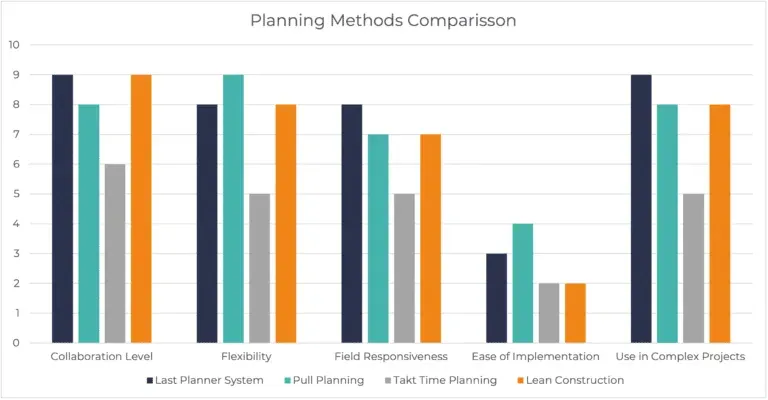
Reference: Planning Methods Comparison
| Feature | Last Planner System (LPS) | Pull Planning | Takt Time Planning | Lean Construction |
| Definition | A collaborative planning system aimed at increasing reliability by focusing on what can and will be done. | Downstream teams define their needs first, and upstream teams plan accordingly. | A Lean method focusing on setting a consistent work rhythm across zones and trades. | A philosophy and system aimed to maximize value and minimize waste throughout construction. |
| Core Idea | Commitment-based planning involves the people who do the work. | Reverse-engineering a schedule from the milestone back to today. | Flow efficiency through synchronized, predictable production cycles. | Empowering teams, improving flow, and delivering value continuously. |
| Timeframe | Multi-tiered: Master Plan → Phase Plan → Lookahead Plan → Weekly Work Plan → Daily Huddles | Often used within Phase Planning or Lookahead Planning in LPS, or standalone for short-term planning. | Structured around daily/weekly intervals with consistent task completion per zone. | Ongoing throughout the entire project lifecycle. |
| Focus | Increasing work reliability through commitment, constraints removal, and continuous improvement. | Aligning teams through backward planning based on milestones. | Smoothing workflow and reducing bottlenecks through rhythm and predictability. | Continuous improvement, waste reduction.. |
| Key Tools | Percent Plan Complete (PPC), Constraint Logs, Weekly Work Plans, Daily Coordination Meetings | Sticky notes, Gantt charts, collaborative sessions, milestone breakdowns. | Takt wagons, Gantt-based visuals, zone-based scheduling tools. | Value stream mapping, A3 thinking, 5S, pull systems, takt planning. |
| Who is involved? | Foremen, superintendents, trade leads – the people closest to the work. | All stakeholders involved in a particular phase, especially downstream teams. | Project managers, planners, and trade leads are executing repetitive tasks. | The project team comprises owners, designers, contractors, and subs. |
| Pros | Promotes accountability, reduces waste, enables continuous improvement, and integrates all levels of planning. | Ensures alignment to project needs, builds trust across teams, and improves handoff between trades. | Creates predictability, improves logistics and handoffs, and is visual and easy to follow. | Broad impact across entire project culture, supports innovation, reduces waste. |
| Cons | Complex and resource-heavy to implement. | May lack rigor or follow-through without integration into a more extensive planning system like LPS. | Less flexible, requires stable conditions and high planning precision. | It requires profound cultural change and takes time to implement effectively. |
Reference: Planning Phase and Construction Methods
| Project Phase | Planning Method Used | Why It’s Used | Example Use |
| Conceptual / Preconstruction | Critical Path Method (CPM) | Baseline schedule for owner, permits, and financing | High-level schedule showing 24-month duration and key milestones |
| Design Development | Pull Planning | Align design deliverables to construction needs | MEP coordination driven by long-lead equipment install deadlines |
| Construction Mobilization | Last Planner System (LPS) | Field team engagement and constraint removal | Foremen commit to weekly work plans based on actual readiness |
| Structural Phase | Takt Time Planning | Repetitive floor construction benefits from rhythm | Each floor is completed every 2 weeks: framing → MEP rough-in → slab pour |
| Interiors / Fit-Out | LPS + Pull Planning + Takt | Multiple trades, tight coordination needed | Daily huddles to plan handoffs between drywall, paint, and MEP finish trades |
| Commissioning | Agile | Fast response to punch items | Weekly sprints to track the open issues |