Field Reporting Software Is Only as Good as Crew Adoption: Lessons From Four EllisDon Sites
How a field reporting rollout hit 99.5% crew participation across four EllisDon sites, and why the whole crew started reporting the good, not just the problems.
Most field reporting software has the same problem. It works in a demo, but the crew never uses it. A few users file reports, because they must. Everyone else is busy with operations and gets little value out of the tool. The app is clunky, and more importantly, it was never built for the people running operations. So the data is thin, and the picture leadership gets is thin with it.
Across four active EllisDon sites, it went differently. Over eight months, crews logged 566 reports, and 99.5% of them came from the crews themselves. Not from a management system. Not from a supervisor filing for everyone else. From the people doing the work.
Here is what changed when the whole crew started reporting, and what their reports revealed.
What stops crews from adopting field reporting technology?
Technology that is not built for crews.
On a typical site, only a few site leaders interact with systems and report. They usually need to
download an app, log in with an email and password, and fill in a form. The system wasn't built for workers without company email addresses or work devices. So workers are excluded, and the record reflects only what a few people can see and remember (or have the time) to log.
When we talk about field reporting, we mean everyone on site. Field intelligence means the whole crew takes part. That requires a platform that a transient population can access without corporate email addresses or devices, and that's simple enough to use in the field. How to get participation is a different conversation that we address in our latest case study, but first we need to address the structural barriers current systems present.
What does full crew participation look like?
Everyone shares what they know.
When that happens, the resolution sharpens. When the people doing the work are disconnected from the systems, even the best technology is incomplete.
On these four EllisDon sites, reporting was one simple step. A worker saw something, good or bad, and sent a photo and a short message by text. No app. No login. No form. That’s a natural instinct, and what they probably are already doing informally.
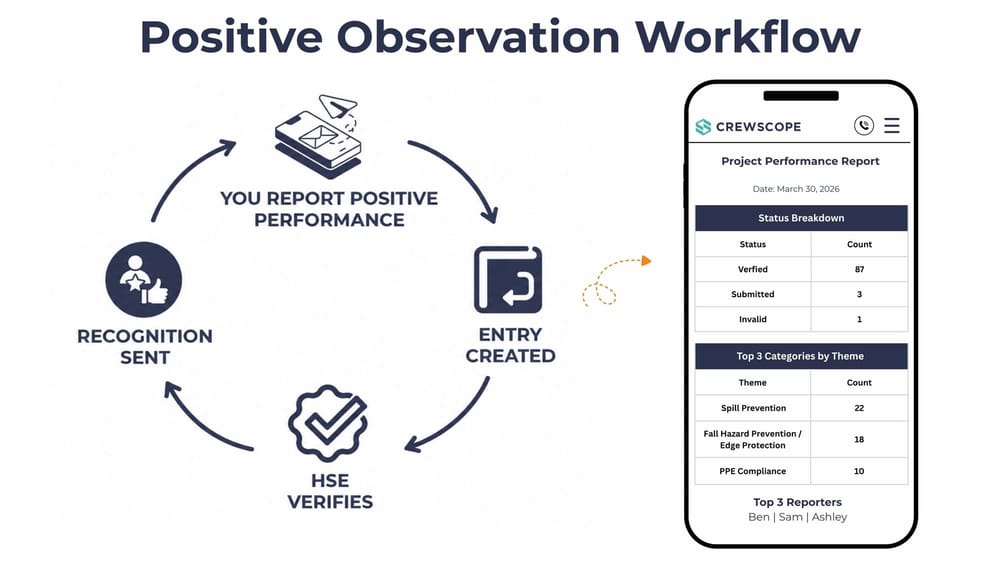
The whole crew participated because there was nothing new to learn. A text is inclusive because you can do it on any device, without a corporate email address. So subcontractors and workers can take part.
Unlock these structural barriers first. That is the first step in how we achieved 99.5% crew participation. Not by pushing harder, but by making reporting so simple it costs a worker almost nothing. That is the difference between unused field reporting software and a connected worker platform the whole site feeds.
What changes when the whole crew reports?
The record starts telling the site's true story.
For years, a field record only filled up when something went wrong. It read like a list of problems, even on a well-run site. At EllisDon, most of the crew’s reports were good, nearly three out of every four reports were positive performance. Or three good observations for every problem.
That ratio is a signal. A record of only problems tells you the system fires when something breaks. A record that leans positive tells you the crew is watching, reporting, and taking ownership of the work. And it held on all four EllisDon sites, not just one. That is a shift in culture, not a one-site result.
Can crew participation catch the blind spots?
Yes. The most valuable insight from the data was what did not get reported.
When the whole crew reports, quiet categories stand out. At these four EllisDon sites, electrical hazards were not observed nearly as often as gravity, even though electrical work was in scope. That imbalance was the signal. Sometimes the big risks takes all our attention, like gravity. It’s obvious, it’s everywhere, and people are focused on it. Broad participation made the gap visible, and the crew started noticing it before it caused harm.
A handful of reports would have shown none of this. You cannot spot what is missing until enough people are reporting for the absence to stand out.
How does this help the wider site?
A significant sample size, none of the admin overhead. Leaders back in the field where they add value.
The crew reports, the software handles the write-up. The report logs and routes itself to close out. On these EllisDon sites, most issues are closed in under a day. The superintendent stops being a scribe and gets back to running the site.
That is the labour productivity win. Not by adding people. But by freeing the experienced people you already have to spend their time in the field, while the software carries the admin. In a market short on skilled workers, extending experience workers to focus only on their highest value activities is the solution.
The software was never the hard part.
Most field reporting software can capture a report. That was never the challenge. The challenge is getting the whole crew to use it, and keeping the admin off your best people.
Get that right, and the record reflects the whole site, the blind spots surface early, and the good-to-bad ratio becomes the clearest read you have on how the work is really going.
That is what field reporting is supposed to deliver. Here is a site that proved it can.
See the full story across four active EllisDon sites in our case study.
Frequently asked questions
What is field reporting software?
It is software that lets crews record what they see on site, progress, hazards, good work, and recommendations, so the record reflects real conditions. The best versions make reporting simple enough that the whole crew takes part, not just supervisors.
Why do most field reporting tools fail on site?
Because crews won't use them. If reporting means an app, a login, or a long form, most workers skip it. Adoption is the real challenge, not the software itself.
How do you get crews to actually report?
Remove the friction. When a worker can report by text with a photo and a short message, participation goes up. On four EllisDon sites, 99.5% of reports came from the crews themselves.
Why does it matter if the whole crew reports?
Because thin data gives a thin picture. When everyone reports, the record reflects the real site, the good work shows up alongside the problems, and gaps like an under-reported hazard become visible early.
Does field reporting improve labour productivity?
Yes. When the crew reports and the software handles logging and routing, supervisors stop doing paperwork and get time back in the field. That puts experienced people where they add the most value, which matters most when skilled labour is scarce.