How to Set SMART Goals for Construction Teams

A shared goal turns a crew into a high-performance team. Here is how to set one.
Key takeaways
Engagement supplies the energy. A shared goal supplies the direction. A crew needs both.
“That’s not my job” is a sign of individual goals. A team goal replaces it.
A SMART goal is specific, measurable, achievable, relevant, and time-bound. It turns a vague plan into a clear target.
Set goals weekly, set them with the crew, agree in advance what adjusts them, and make progress easy to see.
On a crew without a shared goal, you hear four words: “That’s not my job.” On a crew with one, you hear something else. At Amrize’s Dundas Quarry, the plant manager noticed that when break ended, crews started saying “let’s hit targets” instead of waiting to be told what to do.
Those four words slow a whole job down. They mean people are working beside each other, each focused on their own piece. Teamwork cannot be forced. It comes from a shared goal. When the whole crew works toward the same target, people coordinate and clear each other’s blockers instead of each doing only their own piece.
Why does a construction crew need a shared goal?
Because construction is a team sport, and the schedule proves it. Every project runs on a critical path, and one trade’s work sets up the next. When the plumber finishes on time, the next crew can start on time. If everyone plans only their own piece, the pieces do not add up to a finished project.
In Part 1, we looked at how engagement gives a crew the energy to perform. A shared goal gives that energy a direction. Without one, even motivated people pull hard while the person next to them has no clear target, so the effort does not add up. The people carrying the load end up carrying it alone.
What are SMART goals for construction teams?
A SMART goal is clear enough that nobody has to guess. It has five parts: specific, measurable, achievable, relevant, and time-bound. On site, they look like this:
Part | What it means | On-site example |
|---|---|---|
Specific | Say exactly what gets done and where. | Pour the east footing. |
Measurable | Put a number on it, so you know when it is done. | 100 cubic meters of concrete. |
Achievable | Stretch the crew, but keep it possible. Agree in advance what adjusts the target. | A number the crew helped set, based on last week’s results and this week’s conditions. |
Relevant | Pick the task that moves the project forward this week. | The pour that releases the next trade. |
Time-bound | Give it a clear deadline. | By Friday. |
Put it together, and “work on the foundation” becomes “pour 100 cubic meters of concrete in the east footing by Friday.”
The first is a hope. The second is a target a crew can see, aim at, and know when they have hit.
A real example: weekly goals at Brechin Quarry
At Amrize’s Brechin Quarry, a unionized crew of 21 across three shifts worked to two weekly goals: produce 47,500 metric tonnes from the primary plant, and complete 27 of 30 daily inspections. The crew agreed in advance on what would adjust the targets: a prorated target for holidays, 1,000 fewer tonnes for every hour of scheduled downtime, and half the daily volume target on days of significant rain or snow.
The early cycles hit only 50% of targets. Leadership kept the targets in place, worked through the obstacles with the crew, and supported them in fixing those. After six months, the crew was hitting 80%, weekly production was up about 35% on average, and daily inspections consistently met the target. The misses showed leadership which obstacles to fix.
How to set weekly goals your crew will own
Set the goal with the crew. At the Glenhill Condominium project in Toronto, Lanterra’s site foreman and Global Precast’s crew set each week’s goals together, typically at Friday noon. Here is a simple routine based on that approach:
Block 15 minutes at the end of the week, at the same time every week.
Check the key milestones against the master schedule and with your project manager.
Ask the crew what is realistic. Use last week’s results and the coming week’s conditions, such as weather, equipment availability, and site hours.
Write the assumptions next to the goal, such as crane time. When an assumption changes, adjust the goal and tell everyone.
Share the goal with every worker, and update progress daily.
At Glenhill, the first few cycles took some adjustment. The team had not paid much attention to weather forecasts, and quickly saw how hard a target is to hit without them.
The last step matters most. Reach the whole crew, not just the people who walk past the board. Crewscope sends the goal to every worker by text, so everyone can see the target and their progress without leaving the work to check a board.
What changes when it works
At Glenhill, Global Precast’s crew hit its weekly goals more than 95% of the time and installed 1,210 precast panels, finishing eight days ahead of schedule when, at the start, there was little hope of making the critical milestones. Global Precast’s leadership said the crew beat its average weekly installation rate by almost 40%. In the crew survey, 100% said they better understood expectations.
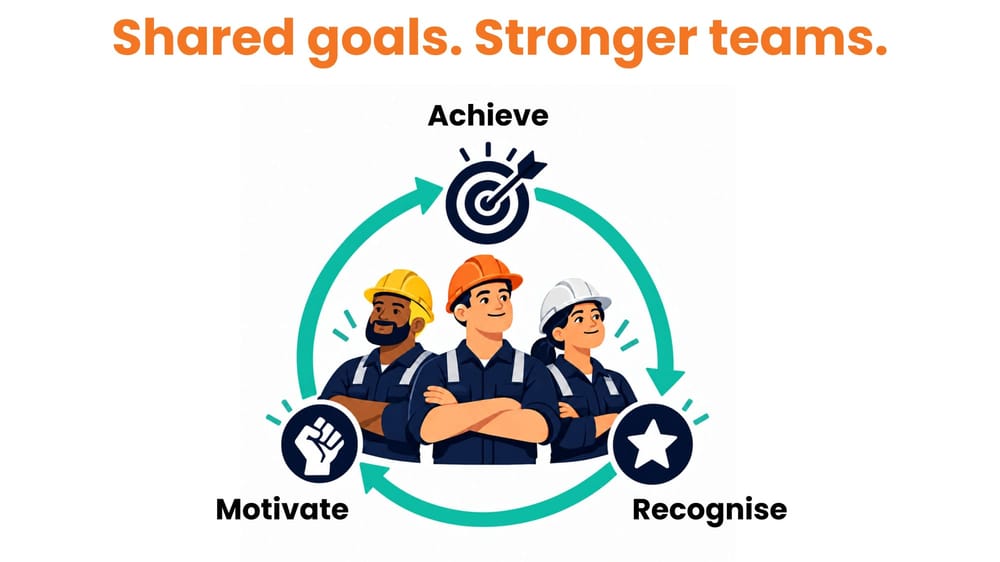
Here is the loop that makes it last. The crew hits the goal, the work gets recognized, and people come back next week more motivated. Engagement feeds the goal, and the goal feeds engagement. An engaged crew with a clear, shared goal is a team with the same purpose.
See how it works on a real site. Book a walkthrough.
Frequently Asked Questions
What are SMART goals in construction?
SMART goals are specific, measurable, achievable, relevant, and time-bound. Instead of “work on the foundation,” a SMART goal is “pour 100 cubic meters of concrete in the east footing by Friday.” They give a crew a clear target and a clear way to know they hit it.
How do you set goals for a construction crew?
Take 15 minutes at the end of the week. Check milestones against the schedule, ask the crew what is realistic, and write down the assumptions next to the goal. Then share it with every worker and update progress daily.
Why are team goals better than individual goals?
Construction runs on the critical path, where each trade’s work sets up the next. A shared goal keeps trades pointed the same way and gives them a reason to coordinate, which individual goals leave to chance.
How often should a construction crew set goals?
Weekly works well. Brechin Quarry and the Glenhill precast crew both ran weekly goals with daily progress updates, which gave the crew regular chances to hit the target.
Do shared goals improve construction labor productivity?
They can. At Brechin Quarry, weekly production rose about 35% on average after six months of weekly goals. At Glenhill, a precast crew hit its weekly goals more than 95% of the time and finished eight days early.