Construction Labor Productivity & Technology | Crewscope
Construction Labor Productivity: The Technology Underinvestment Problem
Labor productivity in construction is declining.
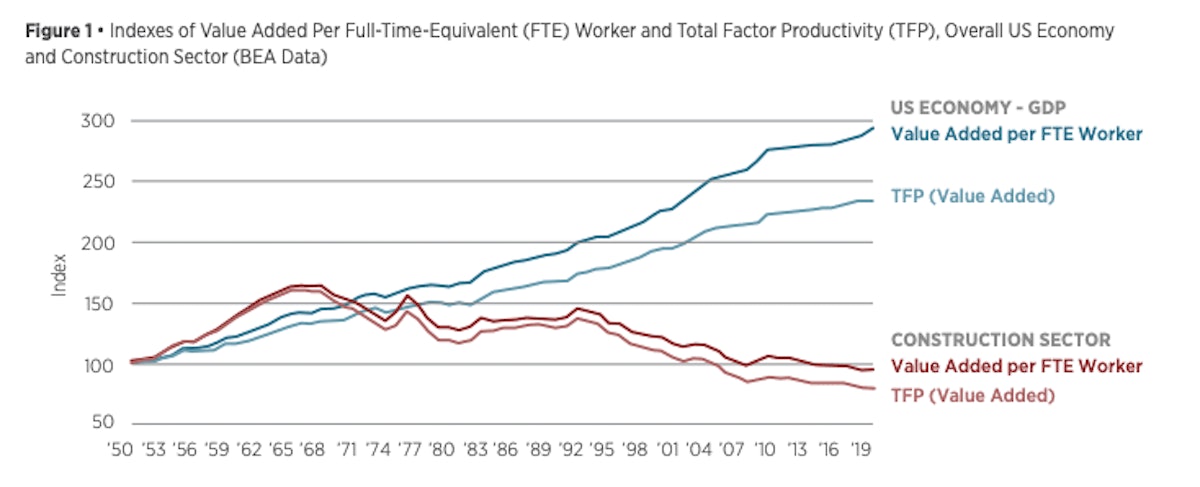
A recent study by Syverson & Goolsbey, economists at Chicago Booth and the Federal Reserve, confirmed what many of us already know.
Productivity in construction has declined by 1% per year since 1970, while other industries saw increases of around 2% during the same period. Add it up over 50 years, and there is a 3x gap between construction output and other industries.
What does declining Labor Productivity in Construction mean in practical terms?
Projects take longer to complete and are more expensive. Houses, hospitals, schools, and roads take longer and are costlier. Our standard of living is declining as we get fewer social services for every dollar.
Some of the productivity declines are desirable and positive. For example, significant improvements in health and safety have undoubtedly saved lives.
Declining Productivity, the Labor Crisis, and Misaligned Incentives
Declining productivity is unsustainable, exaggerated by the labor crisis. The industry needs more labor to complete the same work, just as 40% of workers are retiring by 2030.
With fewer workers, construction wages are increasing. Consider that labor costs are ~50% of project costs. To adapt, 1. project margins get cut in half, or 2. project costs get passed on to the buyer. To illustrate:
Status Quo:
Project 100 = Labor 50 + Other 40 + Margin 10
+10% Labor Costs:
- Project 100 = Labor 55 + Other 40 + Margin 5
- Project 105 = Labor 55 + Other 40 + Margin 10
The labor crisis is only part of the story. Misaligned incentives across the value chain contribute significantly to the problem:
- General Contractors get paid for cost-plus bids, meaning that efficiencies reduce margins.
- Subcontractors often win jobs with the lowest bid, encouraging them to recover slim margins with change orders.
- Workers usually get paid hourly, incentivizing time-in.
The labor crisis and misaligned incentives help to explain why the industry has been slow to adopt new technology.
We could push the problem down when there were plenty of workers by forcing people to work harder with threats and low wages.
We could push the problem down to homebuyers and taxpayers with inflated costs and cheaply financed debt when interest rates were low.
But what about today, when interest rates return to historically average levels and wages increase?
Crewscope’s Role in the Transformation
At Crewscope, we recognize the nuances of declining labor productivity. To bridge the gap between industry traditions and technological progress, we believe the solution must:
- Align incentives and pay for performance
- Create extraordinary experiences workers prefer over alternatives
- Increase field transparency with simple-to-use technology
Getting this right unlocks a future where construction is synonymous with productivity and profitability. It means we can afford a home and live in communities with good public infrastructure. It means that our standard of living can improve along with the pace of technological innovation.
Further reading
See some of our other blogs: Unlocking Worker Productivity, Building High-Performing Teams, and Simple Industrial Tech for the Frontlines.