AI-Native, Not Bolted On: What AI in Construction Should Do on Site. Part 2
Not all AI in construction management is the same. An AI-native platform does the work for you. A bolted-on chatbot just tells you how. Here is the difference.
The case is simple. Good construction technology should take work off your plate, not pile more on. It should pick up what happens on site as the work happens, and turn it into something useful, without anyone stopping to feed a form. The question is which kind of AI can actually pull that off. Because plenty of what gets sold as AI in construction management cannot.
What Does AI-Native Actually Mean?
People throw this word around, so here is what it really means in plain terms.
AI-native means the AI can do everything you can do in the software. It knows the software, it knows your data, and it knows you. It is not a help box off to the side. It is the thing that actually does the work.
Think about the chat assistants bolted onto your bank or your phone provider. You can ask one to move money to your mother, and it will tell you where to click to do it yourself. It will not do it for you. That is a bolted-on chat agent. It has real limits.
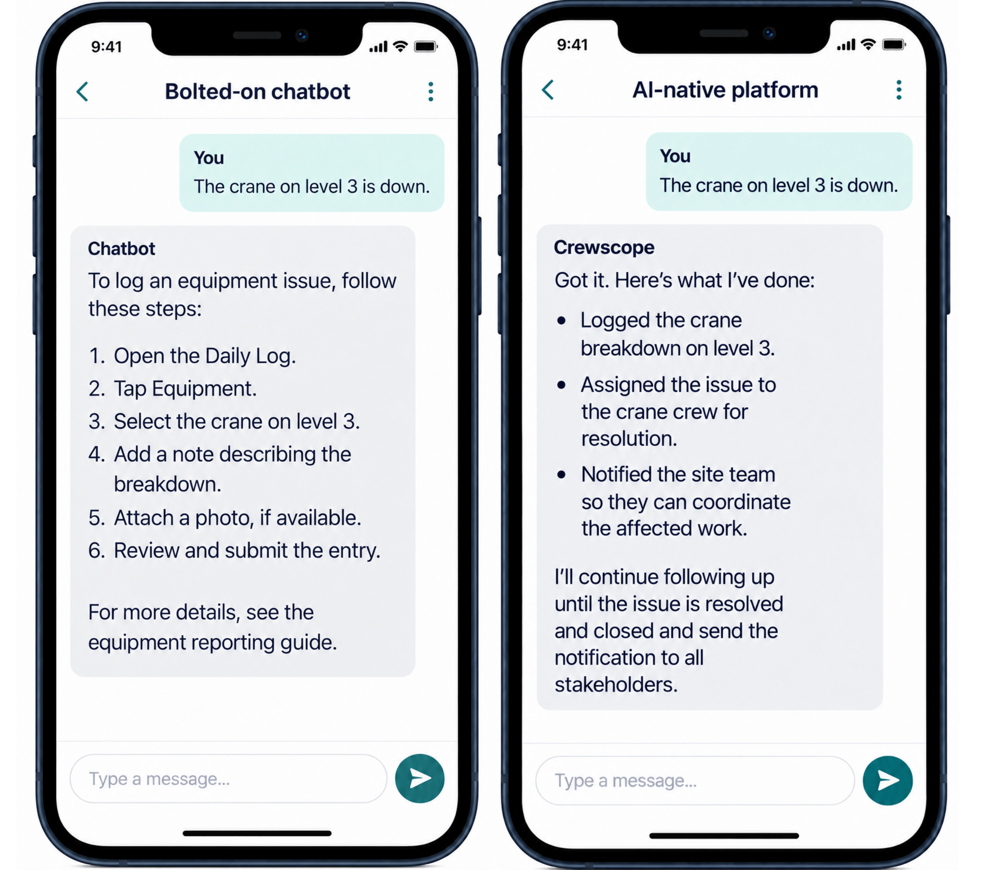
Most AI today is a chat window bolted onto existing software. It answers, it points, but it cannot act. Construction is no exception. This kind of AI technology in construction sits on the side and tells you what to do. It does not take the task off your hands.
How many times have you wanted to tell an AI: do not tell me how to do it, go do it for me.
That, right there, is the line. On one side is an assistant that looks modern. On the other is one that actually takes the job off your hands. Real AI field intelligence lives on the second side.
Here is the difference at a glance:
| Bolted-on chatbot | AI-native platform |
What it does | Tells you how to do it | Does the work for you |
Where it sits | Off to the side, a help box | Inside the software, doing the job |
Your data and site | Starts from zero each time | Knows your site, crews, and history |
Effort on you | You learn how to ask it | It learns how to work with you |
What matters most | Sounds smart | Fast, reliable, same answer every time |
The result | More work on your plate | Work taken off your plate |
Why Do Prompt Libraries Miss the Point?
The moment a lot of teams start using AI, they want to build a prompt library. A list of the exact right ways to ask for each thing. I get why. Someone told them a good report needs colour coding, images, a length limit, and all the rest.
But look at what that actually is. Now you are learning how to talk to the AI, instead of the AI learning how to work with you. Writing the perfect request becomes a job of its own. That is not less work on your mind. It is more.
Here is how I think about it. Imagine you could grab Leonardo da Vinci on the street. Engineer, artist, scientist, all in one person. You ask him how to build a helicopter. He knows everything, so he asks you everything back. How high. How fast. Is it to carry people, or just a drawing. He has all the knowledge in the world and none of your context.
Now come back tomorrow and ask him something else. It is a different da Vinci. He does not remember you, your last question, or anything you decided. You start from zero every time.
That is what a general AI chatbot is like. Clever, but it does not know your site, your crews, your history, or how you like things done. Give it all of that and the answers get sharp. Most site leaders do not have the hours to sit and feed it all that background by hand. That is why the AI has to live inside your world, not stand outside it.
Do We Really Need Smarter AI?
The industry keeps racing to make models smarter. On the frontline, that is not the thing that matters most.
A site leader does not want to wait two or three minutes while a clever model thinks out loud. They want an answer that is fast, reliable, and the same every time. Human and AI interactions on site work best when they are predictable. Ask the same question on Tuesday and Thursday, and you should get the same answer.
Smart enough is already here. What the field needs now is dependable. Faster, more reproducible, and steady under pressure beats clever every time.
Where Does This Leave the People on Site?
Put it all together and it is simple. The best software or solution is the one that takes work off your plate instead of piling more on. It picks up information as the work happens, makes sense of it, shows you what matters, and acts. It knows your site because it lives in it.
That is what we set out to build. Workers text, talk, or send a photo, and the AI takes it from there. It captures it, sorts it, sends it to the right person, and follows it through. No login, no new habit to learn. The worker becomes the sensor, and the system does the heavy lifting from there.
That is the point of AI field intelligence. Not a smarter software or solution for people to serve. A dependable one that serves the people doing the work.
So here is the whole argument. Software should carry the load, not add to it. The best frontline technologies are the ones people barely notice, because they just work. And the AI worth having is not the smartest one in the room. It is the one that knows your site and does the job.
Want to see what AI field intelligence looks like on a real jobsite? Book a walkthrough with the Crewscope team.
Frequently asked questions
What does AI-native mean in construction?
AI-native means the AI can do everything you can do in the software. It knows the software, your data, and your site, and it does the work instead of telling you where to click. That is the difference between an AI-native platform and a bolted-on chatbot, which sits off to the side and only points you to the task.
What is the difference between AI field intelligence and an AI chatbot?
A chatbot answers questions and tells you how to do things. AI field intelligence does the job for you. It picks up what happens on site, makes sense of it, sends it to the right person, and follows it through. A chatbot starts from zero every time. AI field intelligence knows your site, your crews, and your history - in short "it knows your context".
Do construction sites need smarter AI or more reliable AI?
More reliable. On the frontline, a site leader does not want to wait while a clever model thinks out loud. They want a fast answer that is the same every time they ask. Human and AI interactions on site work best when they are predictable. Smart enough is already here. What the field needs now is dependable AI you can trust.
Why do prompt libraries not work well on site?
Because they put the work back on you. A prompt library means learning the exact right way to ask the AI for each thing, which becomes a job of its own. Good AI in construction management should learn how you work, not force you to learn how to talk to it. If you have to write the perfect request every time, that is more work on your plate, not less.