How to Retain Construction Workers
By Calvin Benchimol7 min read
Crews stay where their good work gets noticed. Here is how to recognize it on a jobsite.
Key takeaways
- Replacing one construction worker costs an estimated $15,000, and construction employers see more separations each month than private employers overall.
- In Pew’s survey of workers who quit, low pay, no chance to advance, and feeling disrespected were the top three reasons. A competitor can match a wage. Respect takes longer to match.
- Recognition works when it is specific, fast, given by name, and tied to the behavior you want repeated.
- Three ways to do it: an instant note from the person who saw the work, monthly team meetings against clear criteria, and training built from real examples on your own site.
Picture a carpenter on a forming crew. Before the pour, he notices a brace that is not seated right and fixes it. Nobody sees it. Nobody says a word. Six weeks later, he takes a job across town.
On paper, that is one gap to fill. On site, it is a crew running with one less person taking initiative, a new hire getting up to speed, and a super with one more thing to cover. This post is about how to retain construction workers by recognizing good work, without spending an extra dollar.
What does turnover cost on a jobsite?
The Building Talent Foundation estimates that replacing one construction worker costs about $15,000. The Center for American Progress reviewed 30 case studies and found that replacing an employee typically costs about one-fifth of annual salary for most positions. That covers recruiting, onboarding, the weeks before a new hire is up to speed, and the overtime the rest of the crew works to cover the gap.
Construction also loses people at a higher rate than most employers. In 2025, separations averaged 4.0% of jobs a month in construction, compared with 3.6% across all private employers. That figure includes layoffs and seasonal cutbacks as well as people who quit. On a jobsite, people move often.
Why do construction workers quit?
Pew Research asked workers who quit a job in 2021 why they left. Low pay (63%), no opportunities for advancement (63%), and feeling disrespected at work (57%) were the top three reasons.
Pay is real, and a raise helps. A competitor can also match a wage by next Monday. Whether a worker feels respected and sees a future is much harder to match.
The Building Talent Foundation surveyed close to 1,500 residential and commercial construction workers and found the same pattern. Career development was the top reason to stay (53%), and how a boss treats them came second (45%). Pay ranked second as a reason to leave and fourth as a reason to stay.
What does good recognition look like on a jobsite?
On many sites, the system notices what goes wrong. Someone gets pulled aside after a near miss. Almost nobody gets pulled aside after the 25th pour goes right.
Good recognition is specific, so the worker knows what they did. It is fast, within a day. It uses their name, and it goes on the record. And it points at the standard you want the rest of the crew to match. Here are three ways we do it with crews today.
1. Send the note the moment it happens
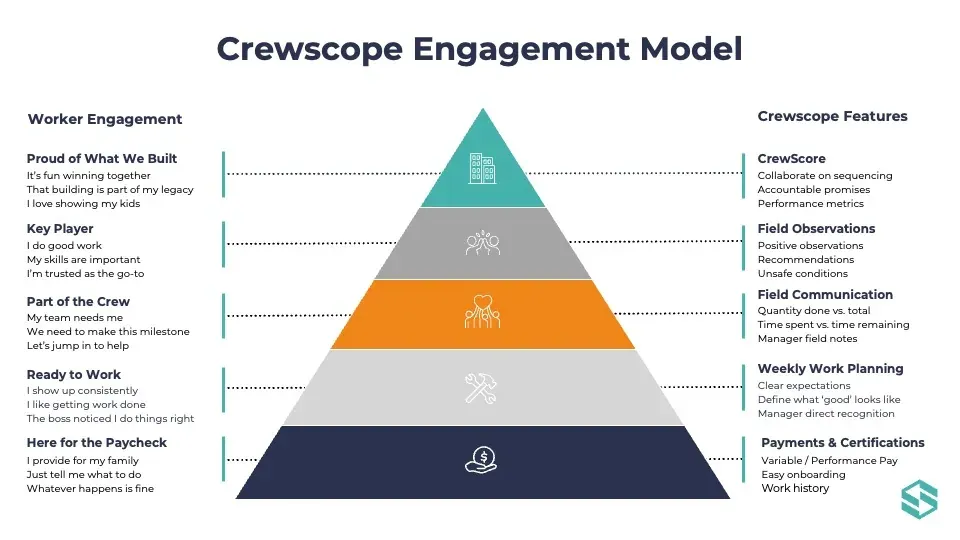
When a foreman, super, or safety lead logs a positive observation, Crewscope AI drafts a note from the observer to the worker and sends it by text instantly. A laborer who set up edge protection before anyone asked hears about it that afternoon, from the person who saw it.
The worker’s name goes on the project record for doing the work well. The note also goes into the worker’s profile, so over time they build a record of good performance they can point to.
2. Recognize against clear criteria at the monthly meeting
Once a month, highlight the workers who showed the kind of participation your site wants. Set the criteria around the culture you are trying to build. Good starting points are high quantity, high quality, teachability, initiative, and doing the right thing when it was hard to do.
That last one is worth saying out loud. A worker who stops work because of an unsafe condition, when the crew is under a deadline, is doing the hardest part of the job. Name them and say what they did in front of the crew. Clear criteria keep it fair and show everyone what counts.
3. Build site training from your own best work
Most site training starts with what went wrong (think safety stand down). Build toolbox talks and site-specific training from real examples instead and highlight the workers who set the ceiling. Crewscope AI turns the week’s observations into a toolbox talk with examples from your own site. Crews learn the standard from their peers.
What does this look like in practice?
EllisDon’s civil division put this to work across four sites from January to July 2026. Crews logged 556 field observations, and 99.5% came directly from the crew. For every problem they flagged, they logged nearly three examples of good work, and most issues closed in under a day. People logged the good work because it was finally seen.
Doug Van Moorsel, EllisDon’s Regional Director of Health, Safety and Environment, described the goal this way:
“We wanted a modern way to recognize positive safety performance, one that was easy for everyone on site to use without creating more paperwork.”
On EllisDon’s Capital Line LRT project in Edmonton, the crew had quantitative weekly goals. Leadership recognized the crew when they achieved targets, and reported improved retention and morale. Site leadership said:
“The crew is thinking about production now, whereas before, the attitude was, ‘Whatever happens is fine.’”
The same pattern holds outside building construction. At Amrize’s Brechin Quarry, north of Toronto, 21 unionized workers across three shifts set production and maintenance goals with site leadership. Early on, the crew hit about half of them. Leadership held the targets, saying they believed in the crew, and worked through the obstacles with them. After six months, goal achievement was up to 80% and weekly production was up an average of 35%. The program is still running today.
A Brechin crew survey found that 73% felt more motivated at work, 93% said the program improved culture and outcomes, and 67% said they would be disappointed if it stopped. A crew that would miss the program is a crew that is invested in the site. The plant manager described the shift this way:
“When break time ended, the crew started saying ‘let’s hit targets’ instead of waiting to be told.”
One crew member said:
“It keeps everyone involved and actively trying to meet the goals, which in this case is paperwork and tonnage!”
How do you start recognizing your crew?
- Pick three to five behaviors you want more of, in your own words. Consider: quality, initiative, and doing the right thing when it is hard.
- Make it easy to log a good observation. If it takes a form, it will not happen.
- Recognize within a day, by name, from the person who saw it.
- Read out a few of the best observations at the monthly meeting, against your criteria.
- Build a toolbox talk from positive performance observed on your site.
Crewscope runs all three practices by text, with no app and no login. Book a walkthrough to see it on a real site.
FAQs
Why do construction workers quit?
Across workers who quit a job in 2021, Pew found the top reasons were low pay, no opportunities for advancement, and feeling disrespected at work. In a Building Talent Foundation survey of construction workers, career development was the top reason to stay, and how a boss treats them was second.
How much does it cost to replace a construction worker?
The Building Talent Foundation estimates about $15,000 per worker. The Center for American Progress found that replacing an employee typically costs about one-fifth of annual salary for most positions, counting recruiting, onboarding, and lost productivity while a new hire ramps up.
Does paying more fix construction retention?
It helps, and low pay is one of the top reasons workers leave. A competitor can match a wage, so pair pay with respect and a path forward.
How do you recognize construction workers?
Be specific, be fast, use their name, and tie the recognition to the behavior you want repeated. Send a note the day it happens, recognize workers against clear criteria at monthly meetings, and build training from real examples on your own site.
How do you reduce turnover in construction?
Start with the three top reasons workers give: pay, advancement, and respect. Recognition is the one a site leader can start tomorrow, with no budget approval.