From Frontline Reporting to Field Intelligence: Closing the Gap on Construction Sites
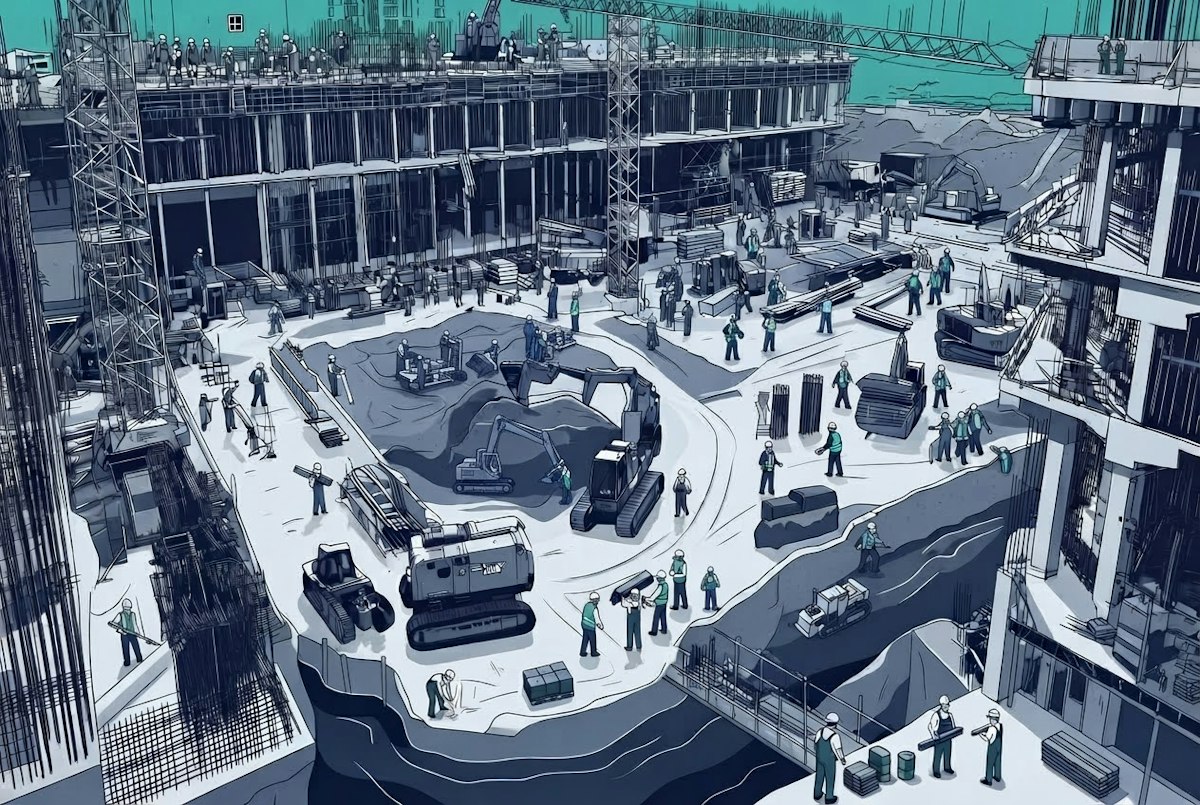
Crews already know what's holding up the work. The gap is how long it takes that to reach someone who can act.
A worker on a site walk spots a damaged conveyor guard. They know what it means - who needs to hear about it, what it holds up, how fast it needs fixing. The only question is how long it takes that information to reach the person who can act on it.
Usually it travels the way it always has: a verbal handoff at shift change, a note on a paper form, a quick word with someone already juggling three other problems. Some of what gets reported lands. Some of it doesn't - not because anyone dropped the ball, but because there's no reliable path for it to travel. What doesn't land doesn't disappear. It comes back weeks later as a delay nobody can trace to its cause.
That's the real cost. Not the damaged guard. The time between someone noticing it and someone fixing it. Closing that gap is what field intelligence means.
Why frontline reporting still gets lost
Heavy industry productivity has declined for decades, and the explanations usually point at labour, materials, or complexity. Those matter. But a simpler answer exists: the frontline still runs on paper and verbal handoffs, while the office runs on systems, and almost nothing moves cleanly between them.
Meanwhile, clients want more transparency. The people best positioned to provide it, the crews closest to the work, are the furthest from the systems that record it. The burden lands on field leaders, who spend hours a week translating what happened on site into something the office can read.
Workers have always been the earliest intelligence on a jobsite. The problem was never that they don't notice things. The problem is that what they notice stays in their heads.
AI in construction: a layer on top, or a workflow rebuilt
Most AI in construction so far has been added on top of existing construction technology. It’s a chat window dropped on top of software that still expects a login, a form, and a worker to do the entry.
Crewscope rebuilt the workflow with AI at the core. A worker texts, sends a voice note, or snaps a photo. No app, no login, just an SMS. The AI reads the message, identifies the issue, triggers the right workflow, notifies the right people, and chases missing information from the right person until the loop closes.

It also connects to the systems teams already run, like Procore, Fieldwire, Trimble, and Google Docs, so the intelligence coming up from the field lands where the office already works. In practice, that makes those project management tools available to every worker on site, including subcontractors, without asking any of them to learn a new one.
Crew participation is what turns frontline reporting into field intelligence
One careful worker reporting issues is useful. Something different happens when everyone participates.
"The harder problem isn't getting an AI to read one photo and log it correctly," says Ehsan Foroughi, CTO and Co-Founder. "It's getting dozens of people on the same site to text in observations, confident the AI routes them to the right place. That's a multi-agent privacy problem, not a chatbot problem." It's also one of Crewscope's two pending patents, alongside industrial forecasting.
At full participation, forecasting sharpens, patterns surface faster, and every crew benefits from what any one person noticed. That's the measure that matters, and it holds up on site: at UHN Toronto Western Hospital, jobsite adoption reached 100% in eight weeks, with zero permit stoppages.
The site team stays in control
Every decision stays with the people doing the work. Crewscope AI handles the routing, the chasing, and the record. The site leadership team keeps the decisions.
"AI on a job site has to be consistent and predictable, and it always has to keep the site team in control," says Calvin Benchimol, CEO and Co-Founder. "We built Crewscope to behave reliably across every site while staying configurable to how each one runs. SOC 2 is the stamp on that, but the real proof is in how the AI behaves on site every day."
Crewscope completed its SOC 2 Type II audit with no exceptions and hosts its data in Canada, the benchmark enterprise security teams look for, and a baseline for the Tier 1 operators building critical infrastructure.
Crewscope built the workflows with EllisDon site teams over three years. "Our clients are starting to ask for this, and it's part of our bid," says Chris Masse, General Superintendent at EllisDon.

What field intelligence looks like in practice
Across deployments:
10x ROI
6+ hours a week back for each site leader
Not because of the technology itself. Because what a worker notices today reaches the person who can do something about it - today.
See how it works on your site: crewscope.com
Frequently asked questions
What is field intelligence in construction?
Field intelligence is the practice of capturing what crews observe on site and routing it to the right people while it can still change the outcome. Traditional frontline reporting collects information after the fact, often on paper. Field intelligence treats the crew as the earliest source of signal on a project and moves what they notice into the systems the office already runs, the same day.
Do workers need to download an app or create a login?
No. Workers text, send a voice note, or take a photo, the same way they already communicate on site. There's no app to install and no login to manage, which is why adoption doesn't depend on training time or enforcement. At UHN Toronto Western Hospital, jobsite adoption reached 100% within eight weeks, subcontractors included.
How does Crewscope handle data security?
Crewscope completed a SOC 2 Type II audit with no exceptions and hosts its data in Canada. SOC 2 Type II is the standard enterprise security teams look for, and it covers how controls perform over time rather than at a single point. The multi-agent architecture that routes each observation to the right people, and only those people, is one of Crewscope’s two pending patents.